
Nobility
In 18th-century Sweden, nobility was tied to the person the king ennobled and to his descendants according to the rules that applied to nobility.
Sons became noble, and his children in turn became noble.
Daughters were also noble and her dignity was not passed on to her children; the daughters' children were instead considered to belong to their father's lineage.
If she married a commoner, their children therefore normally did not become noble.
The above applies to noble houses 1531, 1532, and 1533. Here you will find their letters patent of nobility from 1719.
With the 1809 form of government, a new system for transferring nobility from one generation to the next was introduced.
This means that only one person at a time is noble. The provisions were in Section 37 of the form of government, and the families that were ennobled according to this system are often called Section 37 families.
A person who has been ennobled or elevated according to this system remains alone with their dignity until their death.
The dignity then passes on to the next in line to become the head, primarily the eldest son of the deceased.
The rest of the family are therefore not noble.
If there was no son or male descendant of any son of the first ennobled person, the family died out.
In this list, I have included only the men who assumed the nobility as heads of the house.
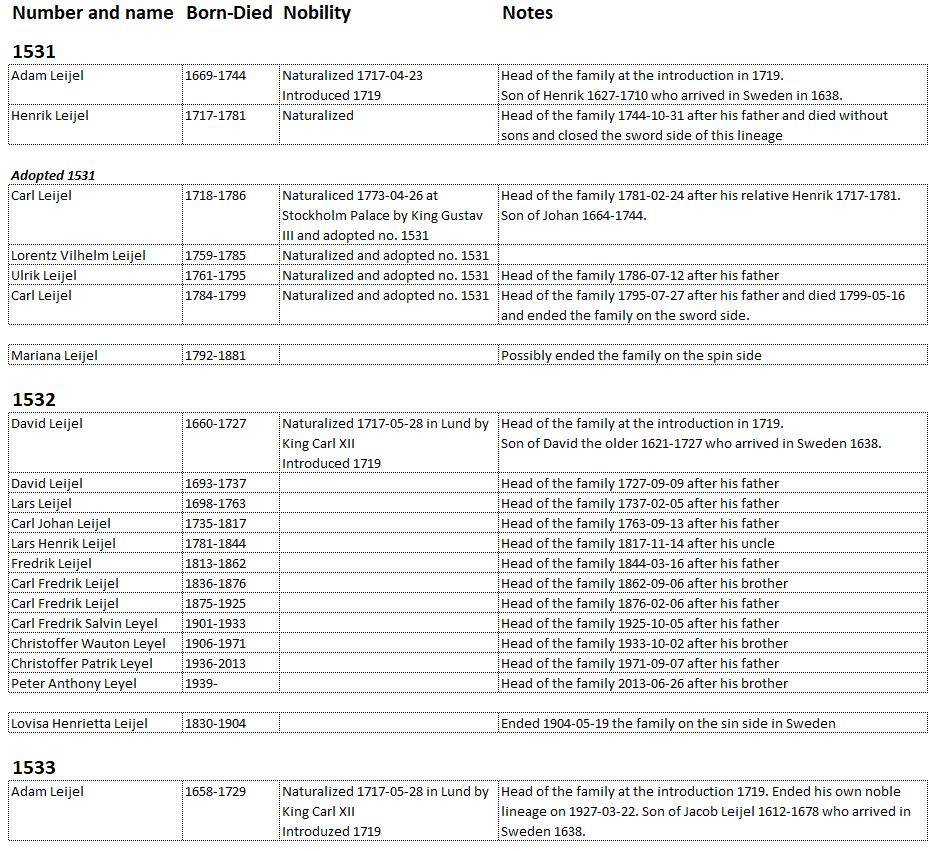
Source: Riddarhuset / Minerva
Note:
Naturalized = the person was already considered to have foreign noble birth, but had their nobility recognized in Sweden.
Introduced = the family was then formally registered at the House of Knights and given a number.