
The history of Älvkarleö Ironworks
The text and pictures here come from Gunnar Ericsson's website, which is no longer available online.
ÄLVKARLEÖ IRONWORKS
The ironworks was founded between 1659 and 1662. More rudimentary ironmaking had, however, taken place
here considerably earlier, as it had elsewhere in Sweden.
Öhn, as the place was then called, had few inhabitants. Records mention only a handful of farms, a small watermill
and a salmon-fishing structure. A nineteenth-century discovery made when a bakehouse was to be built at Näbben
also shows that Öhn had been settled early. During the foundation work, a stone cist was found, made of upright flat
slabs with a slab for a roof. It contained skeletal remains and a clay vessel, but everything was thoughtlessly thrown away.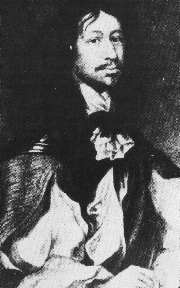
Claes Depken
The founder of the Öhn works was Claes Depken, born in Västerås in 1627. He came from a burgher family and had previously
worked at the Great Copper Mountain in Falun. During the 1650s he saw an opportunity to begin iron production somewhere
along the lower Dalälven River, thanks to abundant ore, forest and water power.
“I, the undersigned, have been at Älvkarleby, half a Swedish mile above the salmon fishery, and there inspected the current,
where it divides into several branches and is locally called Drakesten's Stream, which appears most suitable for a hammer site...
the currents are in every respect suitable and capable of supporting construction without prejudice or harm to anyone; there is
forest in abundance to sustain the works. Oloff Larsson.”
That is the conclusion of the mining official's survey dated 22 February 1659. On 28 February Depken submitted an application
to operate a hammer at Drakenäs and keep the works running. Together with David Leijel, a merchant from Stockholm, he built
Älvkarleö Ironworks and, soon afterwards, Harnäs Ironworks. Leijel was born in Aberbrothock, Scotland, in 1621 and had arrived
in Sweden with his brothers in 1638. In the 1670s Depken helped erect a blast furnace at Hyttön, Axmar Ironworks in Gästrikland
and Galtström Ironworks in Medelpad.
As was customary, the works received exemption from tithes, hammer taxes and other levies for four years after operations began.
Its workers were also exempted from conscription and other obligations specified in the mining privileges.
When war with Denmark broke out in 1675, it soon became clear that the fleet sent into battle by Charles XI was poorly equipped
and, among other things, lacked large anchors. Depken undertook to forge the anchors at Älvkarleö. Previously, anchors had been
forged by hand, a laborious method that limited their size. Depken proposed forging them under a water-powered hammer.
By 1676 he had supplied twelve trial anchors. They passed the test; for this achievement he was ennobled and promptly took the
name Anckarström.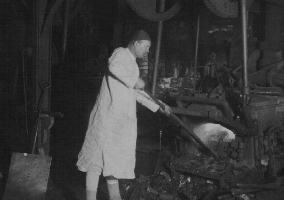
Ulrik Kinn
The successful anchor forging prompted an order from Charles XI granting Anckarström rights to the flow at Söderfors on the Dalälven.
This led to prolonged litigation with Johann Leijonkrona, owner of Untra estate, who strongly opposed the grant. Construction of
Söderfors Ironworks was consequently delayed. The parties were reconciled when Anckarström's stepson married Leijonkrona's daughter.
At different times Älvkarleö Ironworks has borne several names, including Öhns Bruk, Elfkarleby Bruk, Elfkarleby Wercken,
Elfkarleöns bruk and Elfkarleö Bruk.
IRONWORKS OPERATION
After the first hammer was erected in 1659, the lower hammer was built in quick succession, followed soon afterwards by the
blast furnace on Masugnsholmen. In 1726 the furnace burned to the ground and was never rebuilt. Instead, Älvkarleö obtained
pig iron from the Hyttön furnace, built in 1664.
The works escaped destruction during the Russian raids of 1719 when resourceful local residents stopped the raiders at Västanån.
In 1748 the works received permission to build two manufacturing hammers, a plate hammer and a steel furnace. 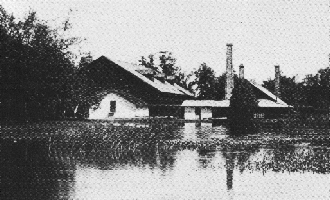
Hammardammen
Another milestone was the introduction of the Lancashire process in 1831, the first use of this method in Sweden. In the 1870s
the smelting forge was rebuilt and a new cementation furnace installed. The resulting blister steel brought the works considerable
attention, including internationally.
Until the end of the nineteenth century, the machinery was powered by undershot waterwheels. These were gradually replaced
by water turbines providing direct drive. Electrification followed, but was not fully completed until 1930. Iron production stopped
entirely from 1920 to 1922, resumed in 1922, and ceased for good in 1924. Thereafter only manufactured iron goods and spring
production remained.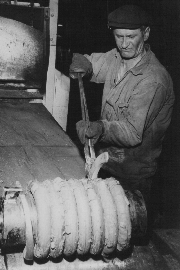
Erik Grufman
Springmaking continued until the works closed in 1972, when all manufacturing ceased. Employees who wished to do so were
offered jobs at Stora's pulp mill in Skutskär. Since the spring workshop closed, several attempts have been made to start other
industries in the premises, without lasting success. One major effort in the 1980s involved mineral-wool production, but that too
closed after a period of operation.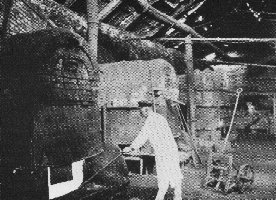
Walloon forge
The works had many owners over the years. Notable among them were founder Claes Depken, members of the Leijel, Tottie and
Tamm families, and the Gävle merchant Carl Östberg.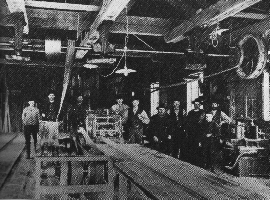
Spring workshop
From 1873 the works was owned by Söderfors Ironworks. When Stora Kopparbergs Bergslags AB acquired shares in Söderfors,
Älvkarleö came into that company's ownership in 1918.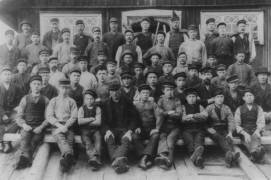
Work crew
SAWMILLING
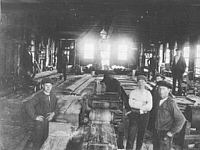
Interior of the sawmill
Two water-powered sawmills were established as early as the late seventeenth century. One belonged to Älvkarleö Ironworks
and the other to Agneta Horn. After her death, her sawmill passed to her widower, Count Fabian Wrede. As far as is known,
it was demolished before 1748.
In the early nineteenth century, the ironworks' sawmill had one saw frame and chiefly supplied timber for its own needs.
A steam-powered sawmill, driven by a 40-horsepower engine, was built in 1887. The old sawmill burned down in 1896 and was
not rebuilt; all subsequent sawing took place at the steam sawmill. Sawmilling expanded until 1907, when the works transferred
all sawing to the then newly developed, efficient mill at Skutskär. That mill had been established in 1868 by Astrup and Sörensen.
THE COMMUNITY
Community services for residents of the works developed relatively early in many respects compared with other industrial villages.
Workers' homes were simple, cramped and owned by the works. Along Bruksgatan stood small red cottages, each containing two
one-room-and-kitchen apartments. Families often had many children.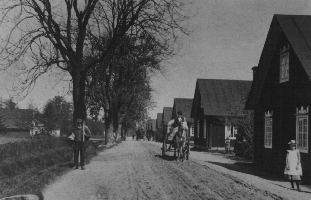
Bruksgatan
Most families kept a cow and a pig for their own use. They also grew food, mainly root vegetables and potatoes. Extensive fishing
helped provide for them; preserved bream was said to be a delicacy.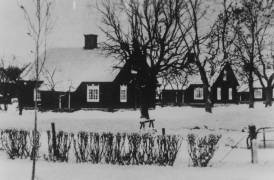
Bruksgatan at wintertime
Life was simple and, for many, extremely poor, with long hard work, illness and bodies worn out prematurely. People therefore
seized every chance for a change or celebration: Midsummer, weddings, and sometimes simply fine weather. The wind-up gramophone
was popular, though few could afford one. The picture includes members of the Siljeholm family.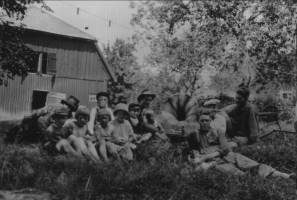
Party
EDUCATION
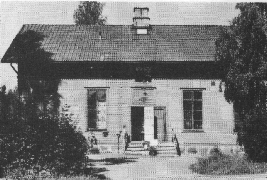
School
A school was established in 1784 in one wing of the ironworks office. In 1824 a donation made it possible to open a
Lancaster-method school. Under this method, older and capable pupils became monitors, or assistant teachers.
The teacher questioned each monitor's group and set new tasks, allowing one teacher to manage many pupils.
In accordance with the donation, Älvkarleö Ironworks undertook to pay 100 riksdaler banco each year for the children's education.
A separate school for younger children opened in 1877. In 1880 the parish's first continuation school was established at
Älvkarleö; a handicraft school for boys followed in 1883 and one for girls in 1885. In 1909 the manager Erik Johan Ljungberg
opened a school of domestic science at Nygård, which continued until 1939. The Workers' Educational Association (ABF) opened
a local library in 1930, housed in the meeting hall on Fjädervägen.
HEALT CARE
A doctor from Söderfors Ironworks moved to Älvkarleö in 1882 and initially lived at Nygård. A pharmacy opened in the east wing
of the manor house in the early 1880s. A dedicated pharmacy building was erected in 1883 and converted in 1890 into a residence
for the works' doctor.
TRADE
The Älvkarleby markets at Midsummer and on St Birgitta's Day were popular and well regarded. Over time they deteriorated.
One parish meeting record called them “a wretched haunt for a few traders from Västergötland, operators of unlawful games
and drinking places, and the like.” The markets were consequently discontinued in the 1830s.
Trading began early under the works' overseer. After a period of private operation, the works took over the company store in
1875 and ran it as a branch of the Söderfors company store. A cooperative shop later opened as well. Itinerant trade was also
lively: herring, eggs and potatoes were sold in this way. The brewer arrived weekly with pilsner and low-alcohol beer, and travelling
haberdashers carried cases full of tempting goods. These sellers provided welcome variety in daily life and often brought news
from nearby villages. The stores stayed open while the works operated, but services gradually declined and closed completely
with the shutdown.
FIRE STATION
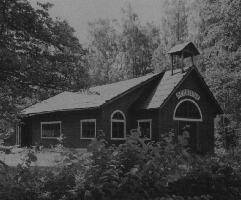
Fire station
The works also supplied other community services, including fire watch and firefighting. A communal laundry was built; even in
the early 1970s, families came from neighbouring communities to wash clothes there at low cost.
NOTABLE BUILDINGS
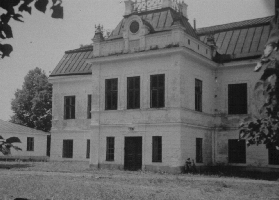
New manor house
A manor house stood approximately on the site of the present one and appears on a map from 1697. It was then occupied by
Catharina Ehrencrona, Claes Depken's stepdaughter. The present manor was erected in the eighteenth century; its two wings
were built between 1789 and 1810. The main building took on its present appearance in 1872. An English-style park was laid
out in 1872–73 and the archive building was erected in 1890–91.
In the eighteenth century, a carefully tended garden was established on Masugnsholmen behind the manor. It became one
of the works' attractions. Fruit unusual for the time, such as peaches and grapes, was cultivated there. At the time of this account
the manor served as the national training centre of the Swedish Women's Voluntary Defence Organisation and hosted extensive
courses and conferences for other clients as well.
Nygård was built in 1697–1701. Its first resident was Anna Odelstierna, a granddaughter of David Leijel who was born at Öhn.
It was then called the bookkeeper's residence and later served, among other things, as a doctor's home and a domestic science school.
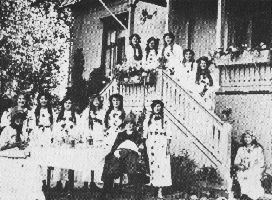
Domestic science school
Members of the Leijel family lived at Nygård until 1872. It was then let to private individuals for many years. Between 1940 and
1947 it was a summer holiday home for children from Falun. A single-storey extension facing the Dalälven was added in the 1950s.
At the time of this account Nygård was owned and run as a community centre by Älvkarleö Folketshusförening. It housed meeting
rooms, a solarium and a gym, and could be rented for private parties. Älvkarleö Sports Association also ran a popular youth centre
there entirely through volunteers.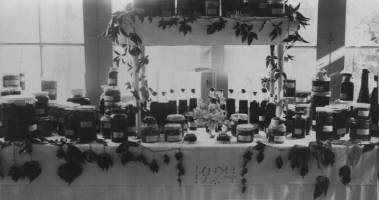
Harvest festival
At the domestic science school at Nygård, local girls learned the skills expected of a capable housewife: cooking and preserving
ingredients, growing food, caring for clothes and managing a home. The summer harvest became jars and bottles of cordial and jam.
The manager's residence, now Bruksgården, was built as a one-storey building in 1697 and housed works manager Petter Leijel.
Its handsome wings were built around the time the ironworks was established.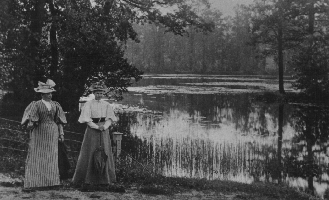
Female office workers
A storey was added to the main building in the late nineteenth century. It served both as the manager's home and the works office.
More recently, entrepreneurs have used it at various times as an inn and restaurant, without much success.
At the time of this account it had a new owner and provided treatment for people with various addictions.
The bell tower, or more accurately the bell house, never had a religious function for the villagers. It was probably a carpenter's
workshop from the outset and later also an electrical workshop. It was probably built in the 1770s.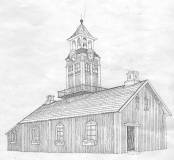
Bell tower
Its characteristic tower carries a bell inscribed:
“ÖHN IRONWORKS
THOMAS TOTTIE
YEAR 1773
CAST BY GERH. MEYER IN STOCKHOLM.”
The building also provided shelter for farmers who came with their horses from far away to grind grain at the nearby mill.
More recently it has served as a sales and exhibition space for art and crafts.
At the time of this account, Älvkarleö Sports Association owned and managed the building and intended to renovate it as a
meeting place for permanent and visiting exhibitions. At midnight every New Year's Eve, Tennyson's “Ring Out, Wild Bells”
is read from the tower, followed by a large fireworks display, one of the village's newer traditions. Volunteers, with financial
support including from the County Administrative Board's cultural heritage unit, have renovated mainly the exterior, replacing
structural parts of the balcony and tower and the roof. Interior renovation is still needed.
THE PEOPLE’S MOVEMENTS
Organised civic activity began early at the works. The IOGT temperance lodge Elfkarlen was founded in 1882, soon followed
by other temperance lodges.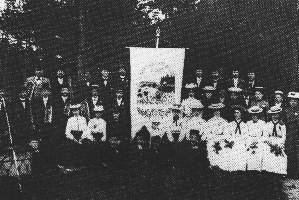
NTO lodge
Organised civic activity began early at the works. The IOGT temperance lodge Elfkarlen was founded in 1882, soon followed by
other temperance lodges. There was considerable rivalry for members among the IOGT, NTO and TA movements. Between 1882
and 1930, nine different lodges existed at the works if their youth clubs are included. They were very active: minute books show
that meetings were usually held every Sunday evening, a common pastime of the period.
Among trade unions, the Swedish Metalworkers' Union was the first to organise, founding branch 181 in 1907. The Swedish
Mission Covenant established its congregation in 1877 and remained active until 1969. Some political organisations had local
branches at different times, including a communist workers' association active from 1920 to 1962. Älvkarleö Sports Association
was founded in 1933 and, at the time of this account, remained active, including in heritage preservation. Its purchase and
renovation of the bell tower is one example.
Music flourished: the Älvkarleö brass band was founded in 1890. As now, active civic organisations needed a good place to meet.
The ironworks built a hall seating 115 people in 1900, and it was heavily used.
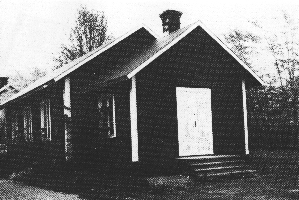
Meeting hall
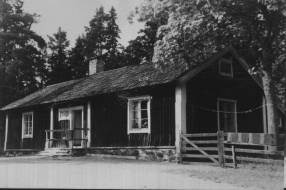
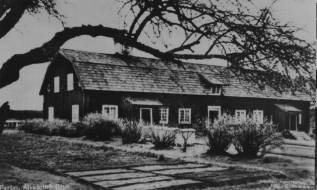
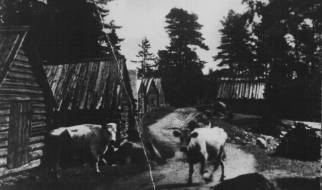
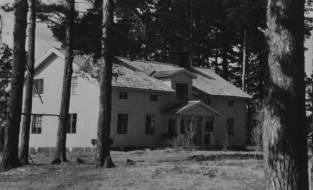
PICTURES FROM ÄLVKARLEÖ IRONWORKS
Pictures shown on this page are from the early 20th century.
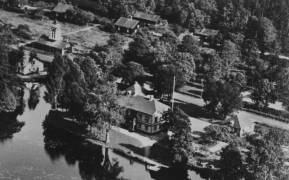
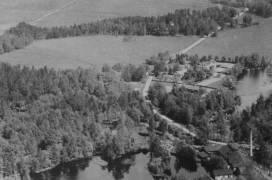
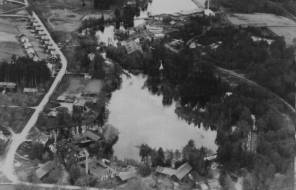
The ironworks is seen here from the air. One photograph shows the ironworks office, another a view to the north.
The subject of the last photograph is unknown.
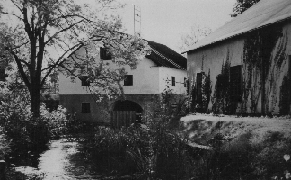
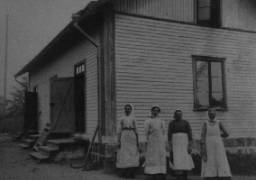
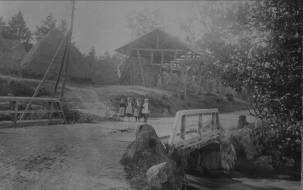
The photograph on the left shows the mill. Taken downstream of the mill, it shows a channel that has since been filled in and
replaced by a pipe culvert. The photograph on the right shows the laundry building by the old school. It shows school cleaners
in the 1920s or 1930s. From left: Carolina Gruvman, Amanda Ekström, Beda Wedlund and Matilda Thunman, who was born in 1856.
The last two worked as school cleaners; the first two helped with major cleanings.
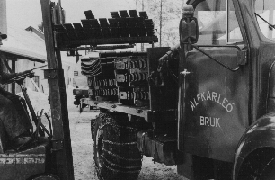
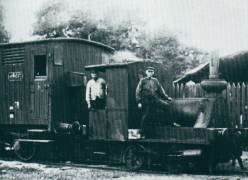
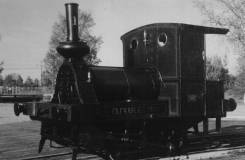
Here are two old stalwarts that many longtime residents of the ironworks village will remember: the works’ lorry and the little
locomotive Lillfutten. The locomotive was built in 1873 by Henry Hughes’s works in England and bought by Älvkarleö Ironworks
in 1876. Today, Lillfutten can be seen at the Railway Museum in Gävle.
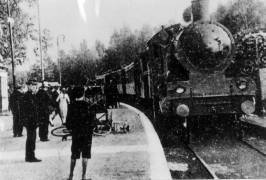
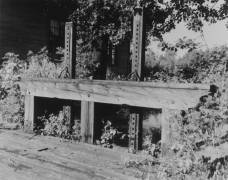
The railway station was always bustling when the trains arrived. The photograph on the right shows one of the sluice gates,
probably the one near Norgevägen.
Here are some of the ironworks’ long-serving workers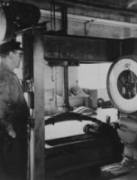
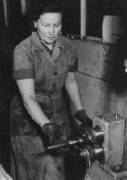
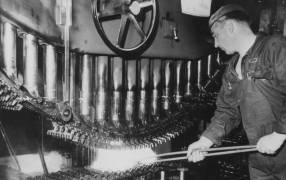
Adrian Strömberg, Lilly Malm, Erik Malm and Otto Alfred e.g.
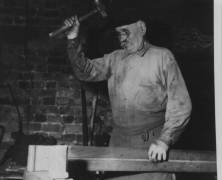
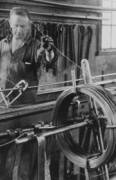
And then we havei David Siljeholm, Gösta Tångfelt and Gunnar Nordström.
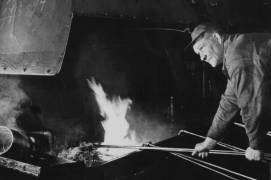
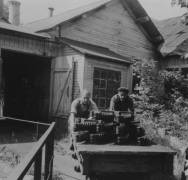
Here is Johan Henrik Frisk, known as “Lång-Frisken.” In the middle photograph, he and Bertil Pettersson are pushing a cart.
On the right is Otto Alfred Nordström.
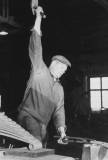
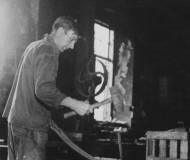
Gösta Bonnevier, known as “Bonne,” swings a sledgehammer beside Karl Malm, who is straightening railway springs.
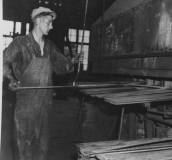
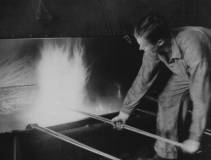
Below, Nils Larsson tapers buffer blanks, while Bengt Ekström hardens buffer springs.
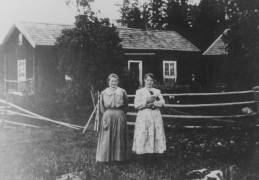
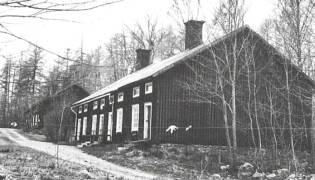
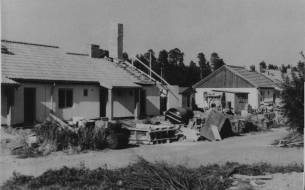
Here we see Linnea Jansson and her aunt at Norrgården around 1915, as well as the houses at Näbben, which were originally
built in Hyttön and later moved to Näbben.
August Lundgren lived at Näbben. The houses at Rackarnäbben were later used as holiday homes, but were demolished in
the 1980s. Some fruit trees and cultivated flowers still grow there.
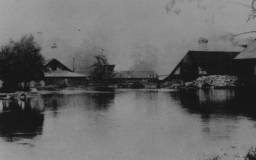
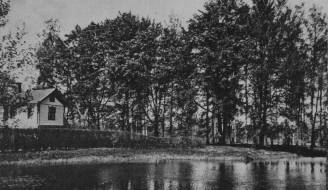
A drawing of the bell tower. Beside it is a photograph of the sawmill pond.
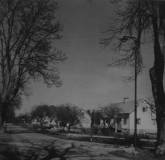
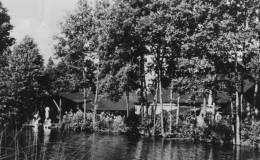
Finally, the photograph on the left shows Bruksgatan in 1946, while the one in the middle shows the bathhouse behind the workshop.
People swam in the pond. David Siljeholm was the first to go swimming each season and the last to stop.
The photograph on the right shows the narrow-gauge locomotive (track gauge 702 mm) known as Lill-futten or Kaffebrännarn.
It is now at the Railway Museum in Gävle, where the photograph was taken.
Road bridge Beech trees
Terraced houses Klockargårdsvägen
Moose-drawn carriage
Spillway Ambricka bridge Log drivers’ hut
Fyrbo Hålldammen Hammarvägen
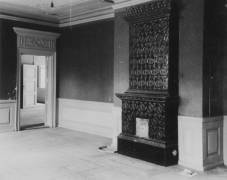
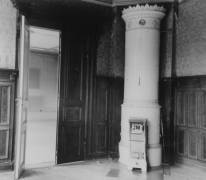
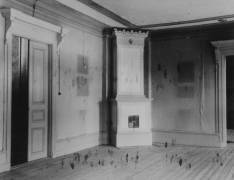
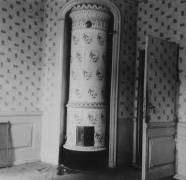
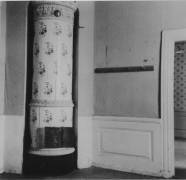
Tiled stoves
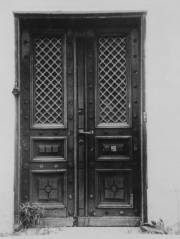
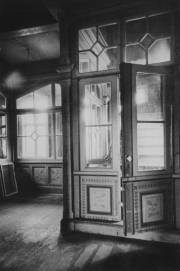
Front door Glass panel in an exterior door
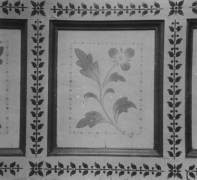
Wall painting
PRODUCTS FROM ÄLVKARLEÖ IRONWORKS
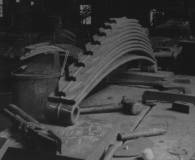
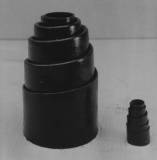
Countless products were made here over the years.
Springs for cars, lorries and rail vehicles became a major line during industrial expansion.
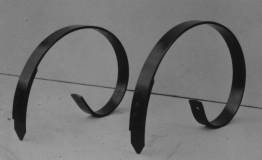
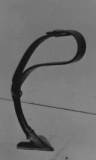
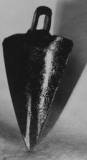
Photographs show leaf springs and buffer springs for railway wagons.
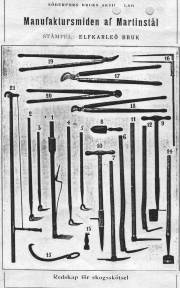
The manufacturing department made many useful articles, including a wide variety of hand tools for forestry;
one picture reproduces a page from a product catalogue.
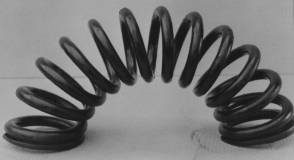
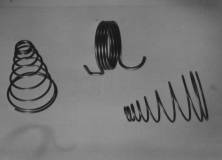
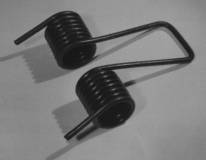
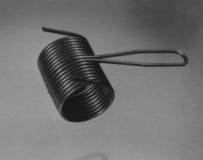
Other pictures show further spring types.
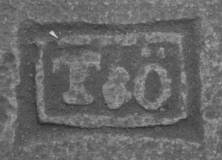
Products made under Tamm and Östberg's ownership bore a particular iron stamp.
MAP OF ÄLVKARLEÖ IRONWORKS 1697
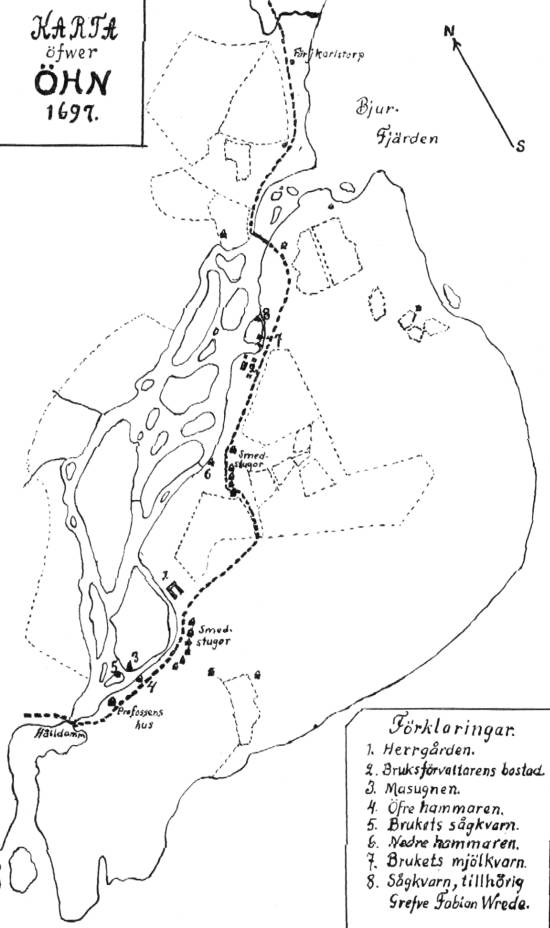
The map shows the works in 1697, about forty years after Claes Depken received his privileges and began construction.
Already in place were the manor, manager's residence, blast furnace, upper and lower hammers, the sawmills belonging
to the works and Fabian Wrede, and a flour mill.
LANFORSENS POWER STATION
Lanforsen's history reaches far back. The falls were mentioned in connection with salmon fishing as early as the sixteenth century,
and disputes over fishing rights also occurred. Salmon traps were still used from platforms in the 1920s. Permission to develop the
falls was preceded by a very long legal process.
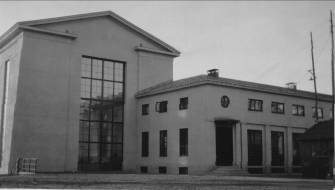
William Olsson and Louis Fraenckel received Lanforsen as a commission for arranging Stora Kopparbergs' purchase of Söderfors
Ironworks, including Älvkarleö. The contract dates from 1908. On the very day it was signed, Olsson and Fraenckel transferred
Lanforsen to Sandvikens Ironworks for one and a half million kronor.
A legal dispute followed between Sandvikens Ironworks and the Crown, which claimed the falls themselves. A 1914 judgment
awarded the rights to Sandvikens. It was appealed all the way to the Supreme Court, with the same outcome.
Work finally began in 1919, but a construction-industry lockout stopped it again the following year. In spring 1926 work
accelerated after the City of Stockholm became a co-owner. The power station was finally completed in 1930. Gustav Berggren,
the builder at Untra, directed the construction.
There were initially only two generating units. A third was connected the next year and the fourth and last began operating in 1948.
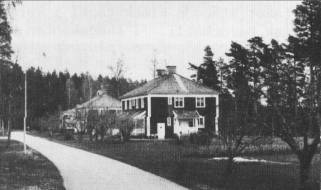
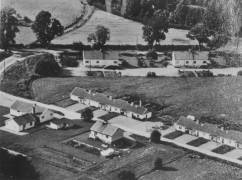
The well-preserved setting includes housing erected in the 1920s in the period's characteristic Nordic Classicist style.
Erik Hahr was the architect, and Gustaf de Frumerie also contributed to the power station project. The houses have Falun-red
vertical boarding and hipped tile roofs.
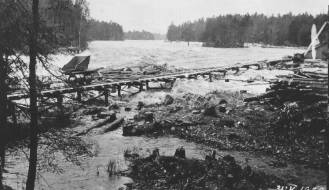
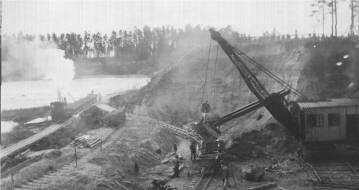
The following photographs show some of the construction of the power station, which took 11 years.
1920 1921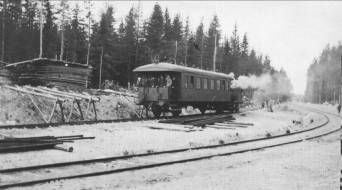
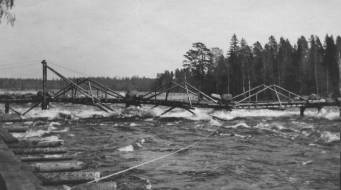
1922 1924
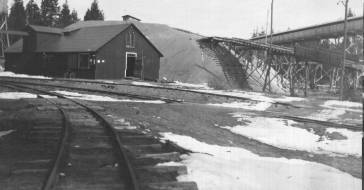
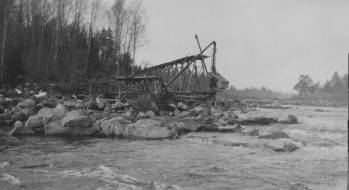
1925 1926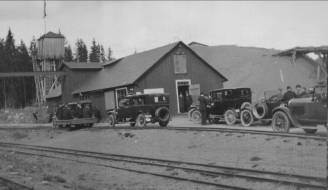
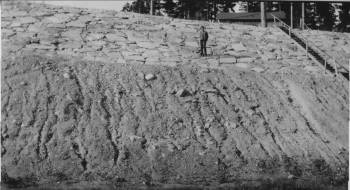
1926 1928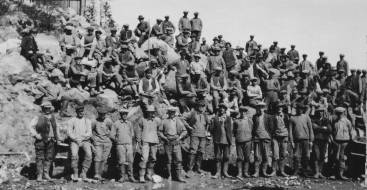
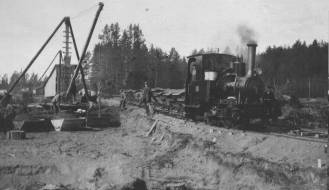
1928 Futt
NOTABLE PEOPLE CONNECTED WITH ÄLVKARLEÖ
Olov Forsgren, builder of the bridge
On 30 January 1774 a boy named Olov was born in a little cottage by Lanforsen. His father, also Olov Forsgren, was master
builder at Älvkarleö Ironworks. His family home, known as “Fors-Olle's cottage,” has long since disappeared. Its foundations
were still visible when construction of Lanforsen Power Station began, but the station's intake channel now passes over the site.
Even as a child, Olov showed an aptitude and interest in machinery. He practised drawing, carpentry, turning and forging, and
made models of buildings and mechanical installations. He built a detailed scale model of one of the hammer forges at Öhn,
subsequently bought by works owner Tottie. He also made a wall clock with hour, minute and date hands entirely on his own.
At nineteen he was commissioned to plan and build a dam at Forsbacka, then owned by Johan af Nordin, the county governor
in Falun. Nordin became his friend and patron, secured him a scholarship of 200 riksdaler a year from Jernkontoret, and encouraged
his study of industrial works and mines. Forsgren's expertise was sought throughout Sweden for dams and bar-iron works.
His best-known construction was the Carl XIII Bridge, built in 1815–16 and regarded as a remarkable feat of engineering. For his
great projects he received the title lieutenant mechanic and later captain mechanic. In 1816 he became manager of Grängshammar
Ironworks in Dalarna, and had to give up much of his beloved building work. He nevertheless managed the works in exemplary fashion
until retiring because of age in 1855. He remained at Grängshammar until his death in 1862, aged 88.
Olov Sverkersson, secretary to Johan III
Olov Sverkersson, one of John III's secretaries, was born at little Nedergården, probably only a farm then but now a village in the
Gårdskär area. He had lost his right hand and had an artificial one made of iron. He attached it to his injured arm when writing or
when he needed it for another purpose. After his death it hung for a long time in Älvkarleby Church in his memory, before being
donated to Skokloster Castle, where it remained among the collections at the time of this account.
Sverkersson often added “Älvkarl” to his name as a reminder of his home district. Historians describe him as one of the most
frequently employed of John III's many secretaries and say that he was cunning. His detractors therefore sometimes called him
the less flattering “Olov Perkelsson.” Olof von Dalin, writing in his History of the Swedish Realm, adds a Latin rendering of that
name to avoid misunderstanding: “filius diaboli,” son of the devil.
Johan Karl Garney, blast-furnace master
Johan Karl Garney was born at Älvkarleö Ironworks in 1740. His father, of Walloon descent, was the manager. Garney became
chief blast-furnace master in the Nora district in 1769 and in Värmland in 1780, and director of pig-iron smelting for the kingdom
in 1791. He worked to improve mining and metallurgy through new methods, described in his 1791 book, Handbook of Swedish
Blast-Furnace Practice. Specialists at home and abroad praised the book, which appeared in several editions. Garney was also a
member of the Royal Swedish Academy of Sciences. He died on 18 April 1808.
Byss-Kalle, our best-known folk musican
Among notable former residents of Älvkarleby was the nyckelharpa player known across much of Uppland and neighbouring
provinces as “Byss-Kalle.” Most of the old Uppland polskas still played today are said to originate with him, and many folk
musicians attribute traditional tunes in their repertoire to him. His full name was Karl Ersson Bössa. Born on 26 April 1783,
he died on 9 January 1847.
He worked as a Baltic herring fisherman and, for many years, as a barge man, carrying iron from the works' depot at Sand in
Östanå to the loading place at Skutskär. He lived in Östanå and fished from a shore hut at Billhamn, which still existed at the
time of this account. His parents were the farmer Erik Jansson Bössa of Östanå and Kajsa Henning. The family was of Walloon
origin and had once been called Boussard, later Swedishised to Bössa. Its immediate roots lay at Älvkarleö Ironworks, where
Erik Jansson Bössa's father Johan was a smelter's assistant. Johan, born in 1714, can be traced back another couple of generations.
His father Erik Ersson Bössa was born around 1640. All were smelters' assistants at the works. The last may have descended from
Nils, or Nicolaus, Boussard, a smelter at Vessland Ironworks. Erik Nilsson Bössa probably moved to Älvkarleö when production
began in 1659.
Few today would recognise the name Karl Ersson Bössa, but few adults in northern Uppland have not heard of Byss-Kalle, the
region's most famous nyckelharpa player. He taught himself, and had exceptional talent, a good ear and an excellent musical
memory. Before long he composed his own tunes, often inspired by slow barge journeys down the Dalälven or by his fishing
trips at sea.
His fine playing made him sought after for large gatherings in neighbouring parishes, including church weddings, Christmas
dances and major haymaking celebrations. He supposedly played best when somewhat tipsy, adding many graceful flourishes
to his polskas. Stories still circulate about the supernatural effect of his music on people and things: more than once, it is said,
tables and chairs danced along when he was in full flow.
According to another story, he kept three nyckelharpas hanging on the wall. Before going out to play he would ask them,
“Which of you wants to go out?” The instrument that “sang” in reply was the one he took that evening. Many strange tales
are told of Byss-Kalle.
On one occasion he was to play at a wedding in Löfsta with another well-known Uppland musician called Gulamåla-Viten.
During the ceremony they stood outside the church with their nyckelharpas, ready for the bridal march as the procession
emerged. They had agreed not to play tricks on each other, yet as they began, the hairs of Byss-Kalle's bow fell out one by
one, until none remained. Prepared for this, he pulled a spare bow from his boot, and the music continued until they reached
the wedding house.
After plentiful food and drink, dancing began. In the middle of the bridal polska, the lowest string on Byss-Kalle's instrument
snapped. He was ready again, although such a string usually lasts ten years and he had fitted a new one shortly before the wedding.
Without a word he calmly put on a replacement. They played for a while longer, until Gulamåla-Viten's instrument suddenly fell
to the floor in pieces. Furious, Gulamåla-Viten rose and clapped his hands before Byss-Kalle, who became completely rigid and
could not move a finger. Byss-Kalle asked someone to take a small bottle from his pocket and give him a drop of its contents.
He gradually recovered; dancing resumed, now without further trouble, for Gulamåla-Viten, deprived of his instrument, left and
did not return.
At another Älvkarleby wedding, a violinist had been hired to play with Byss-Kalle. As they struck up the bridal march outside the
church, all the buttons flew from the violinist's trousers. He had to put down his instrument and dash behind the church wall to
repair his clothes. Kalle played alone that day, and probably nobody minded.
He often named his polskas. One, “Storsvarten,” was supposedly created when a black horse could not pull its load up the steep
road by Carl XIII Bridge. Byss-Kalle climbed onto the load and played the tune, so invigorating the horse that it pulled the load up.
Another version tells of a group of carters from Hälsingland travelling to the Distings market in Uppsala. Their horses could not
manage the bridge hill. Byss-Kalle sat on the leading cart and played a spirited polska; the entire line made it to the top. He had
told the man beside him to snatch the bow from his hand once all the carts reached the summit or things would go badly.
“Good thing you took the bow in time, or I would have had to play myself to death,” he told the driver.
Other tunes were called “Åkerbystålet” and “Byggnan.” The latter arose, the story goes, when the Älvkarleby bell tower needed
repairs. Byss-Kalle and the builder dallied, slowing the work. He wagered that he could compose a new polska as quickly as the
repairs were finished, and “Byggnan” resulted. “Isbrytarn” is thought to have originated one spring when the river ice broke and
blocks danced before the barge he piloted downstream. Its melody suggests ice blocks dancing on the waves and colliding with a crash.
One of his children, Jan Karlsson Bössa, inherited his nyckelharpa and some of his talent and was much in demand as a dance musician.
At the auction after Jan's death, Byss-Kalle's nyckelharpa was sold. Only one was mentioned: the other two had demonstrably been
destroyed by then. Olov Boberg of Östanå bought it, but it subsequently vanished. He rejected several offers to buy it and would
not even show it to potential buyers. People assumed this last instrument too had been lost forever.
It eventually resurfaced by a circuitous route. After travelling as far as Dalarna, it ended up in Uppsala with the printer R. Zaine,
who donated it to the Älvkarleby local heritage association in 1952. At the handover he said that his father, also a nyckelharpa
player, had acquired it from Boberg. Two leading Uppland musicians, Oskar Larsson of Uppsala and Eric Sahlström of Tobo,
examined it. The experts expressed no doubt as to its authenticity, and Sahlström restored it. It became a prized part of the
Gammelgården collections.
At the local heritage celebration in summer 1947, one hundred years after Byss-Kalle's death, a memorial stone was erected
on a rise before Gammelgården. Its inscription reads: “In memory of Carl Ersson Bössa, Bess-Calle, 26/4 1783–9/1 1847. The
district's greatest folk musician. Erected by the Älvkarleby local heritage association, 20/7 1947.”
Olof Rudbeck the Younger on his journey in 1695
“But let us hasten back to the great highway. From it, just by the Älvkarleby ferry, one sees in the middle of the river a long
island with a few trees upon it. This is said to have first appeared in the reign of King John III, cut off from the mainland on
the western side, where the river now runs most strongly and washes more of the bank away each year. Old people remember
that in their childhood they could cross from the mainland to this island on a single projecting saw plank, so small was the
passage of water and so narrow the stream between them where the fiercest current now flows. Even the longest mast timber
would not reach to form a bridge between the island and the western bank.”
Carl Linnaeus on his Lapland journey in 1732
“When I had heard so much talk of Älvkarleby Falls, it seemed worth a short detour to look at them, especially as they could
be seen and heard from the road. A mist rose from them like the smoke of a great fire of shavings rising through a chimney.
“When I arrived, I saw the current divide into three branches, separated by an island founded on rock. This waterfall is no
work of art, but of nature, which has set a strong rock in the middle of the stream. In the nearest of the three branches,
which also drives a sawmill, the water drops some twelve or fifteen ells. It turns white, roars furiously and throws droplets
a couple of ells into the air, so that a constant mist hangs over it. The sawyer, who must always stand amid this spray, looked
pale to me but complained of no particular ailment.
“The falls lie on black bedrock, impossible to examine closely. Below them, at the salmon fishery where the water between
the currents has calmed somewhat, stands a square fence of poles, one ell above the water. Salmon enter it but cannot get out.
Oaks stood on the highest rocks beside the land. I wondered how they found enough sap there, but understood that moisture
from the earth ran over and down the rock to feed their roots.
“In the hollows between the rocks lay snails, Helix lapicida. I also found a rare sulfur-green moss.” [The source adds that in Flora
Lapponica Linnaeus called this moss Bartramla fontana and said he saw it nowhere else on the entire journey in such abundance
as at Älvkarleby Falls. Its leaves resembled verdigris, especially when wet.]
“I hurried from here to Älvkarleby, divided into two parts by this great river, which comes from Lake Leksand in Dalarna.
The greater part lies on the southern side and looks like a town, with many merchants' booths awaiting the markets.
One must have a ferryman to cross; he always asks for a travel pass. When I saw him, I thought of Rudbeck's Charon, whom
he rather resembled, except in age.
“The river is a couple of musket shots across. Midstream I passed the little island cut off from the mainland, a rock at its base
with only one tree upon it. On the north bank I saw a fairly sheer edge and wondered how it stayed so neat. I discovered that
sand mixed with clay made it so. No human art could have made it steeper; horizontal lines seemed to show how deeply the
water had cut into it each year. The sun shone in the morning but rain soon followed.
“On the north side of the road I saw some ancient burial sites. At last I saw a plant I had never observed here in the north,
Pulsatilla appii folio.” [Now called Pulsatilla vernalis, the spring pasqueflower.] “Heavy rain came from time to time and the
sun shone in between. One Swedish mile beyond Älvkarleby we saw Harnäs Ironworks, which takes its ore partly from
Dannemora in Roslagen and partly from Ängsö in Södermanland. The Russians burned this works, but it has now been repaired.
“Here runs the stream that divides Uppland from Gästrikland. The land is mostly clay, the forests sandy soil, with few hills;
the innkeepers are poor. Just as we left Uppland I saw a pair of oaks, but none thereafter. Uppland has few hills and lakes.”
H. C. Andersen made a three-month journey and described our region as follows:
“Above the falls, the Dalälven divides into three arms. Two enclose a wooded rocky island and plunge around its sheer stone
walls; the one on the right carries more water. The third takes a detour and returns to the main stream only below the united
falls, where it bursts forth as though to check its two mighty companions, but is swept away in boiling eddies by the arrow-swift
current. The water races and foams against the masonry pillars supporting the bridge, which seem about to be carried away.
“When we saw the scene, a herd of goats enlivened the left bank, grazing among the hazel bushes and venturing to the very edge.
Bred here, they were accustomed to the water's deep, thunderous roar. To the right, a flock of crying birds flew over the crowns of stately oaks.
“Carts, each drawn by a horse and driven by a man standing upright with the reins in his hands, came along the broad forest
road from Öhn Ironworks. We wanted to go there to take leave of the Dalälven at one of its loveliest places, a spot that transports
a stranger to a much more southern country and a richer landscape than he would expect so far north.
“The road is pleasant. The oaks grow strong and lush, their leafy crowns proud. Öhn Ironworks lies in an idyllic setting.
When we arrived, how busy everything was! Millwheels turned, great beams were sawn and iron was forged on anvils, all by the
power of water. The workers' dwellings make up a whole town: a long street of red-painted wooden houses beneath picturesque
oaks and birches.
“The greenery seemed as soft as velvet. Up at the manor house, which rises like a small castle before the garden, the rooms and
halls held everything an Englishman calls comfort. The master was not at home, but hospitality is always a household spirit here.
We were given everything pleasant and good: steaming, fragrant fish and game birds were set before us, as in a beautiful enchanted castle.
“The garden itself was an enchantment. Beech trees had been planted and flourished. The strong north wind had rounded the
crowns of the chestnut avenue so evenly that they seemed trimmed by a gardener's shears. Golden oranges hung in the greenhouse.
Today the windows had been opened halfway for the magnificent southern flowers, so that the artificial warmth met the fresh warmth
of a northern summer.
“The branch of the Dalälven flowing past the garden is dotted with islets on which lovely weeping birches and pines grow in northern
splendour. Some have still, green groves; others rich grass, tall ferns, bluebells and bright flowers. No Turkish carpet has fresher colours.
The water between the islands is now fast, deep and clear, now like a broad stream of silky green reeds, water lilies and rushes with
brown down, now a brook over a stony bed. Then it spreads into a great still millpond.
“At Midsummer this is a landscape for the water spirit's strings and the dances of the elves. In the full moon the dryad should tell
stories here, and the water spirit take up his golden harp and believe he can be saved, if only for one such night. Beyond Öhn
Ironworks roars the main current, the mighty Dalälven.
“Do you hear that steady thunder? It is not Älvkarleby Falls that sends it here, but nearby Lanforsen, by Askön, where the river
foams and roars over the leaping salmon. Let us sit among the rocks by the riverbed in the red evening sun, which scatters gold
across the water. Glorious river! For a few seconds you labour at the mills over there, then plunge foaming over the rocks of
Älvkarleby into the deep channel that carries you to the Baltic Sea, your eternity!”
August Strindbergs on Älvkarleby
In an extended essay entitled “Swedish Nature,” included in his Prose Pieces from the 1890s, Strindberg briefly wrote:
“Then we stop at Älvkarleby to bid farewell to southern Sweden. For the first time on this journey we encounter a considerable
flow of water. In the Dalälven we have reached a natural boundary between Svealand and Norrland, and a boundary for plant
life all the more decisive because the oak, central Sweden's noblest deciduous tree, ceases to reproduce itself naturally here.
The landscape takes on an aspect of poverty that not even Norrland's timber forests can dispel.
“The river is not as broad as a lake, but may seem mightier through its ceaseless forward movement and, at the waterfall,
its power to break down everything. Amid the quiet landscape it announces itself with a roar beside which the slap of lake
waves against shore stones is a whisper.
“Älvkarleby Falls is a magnificent introduction to Norrland. Little encumbered by clattering waterworks, solitary and framed
by dark spruce forest, it makes a stronger impression than Trollhättan despite its smaller drop and volume. In the nearby
works' park stand five tall beeches and many high oaks like boundary posts, north of the river, as if the gardener wished
to demonstrate the human spirit's power over the limits of vegetation and temperature. In the groves around them still
flourish the delicate linden and the sturdy horse chestnut.
“In the garden greenhouse are vines bearing Alicante grapes, awakened in February and newly harvested in August.
Palms, fuchsias and camellias still testify that the northern summer is warm, though short.”
DOCUMENTS
Historical data based on sources in the Bergslaget archive - E. Liljeroth Länk
Liljeroth appendices concerning metal and wood production and population Länk
Youth club Länk
SOURCES
Älvkarleby, a local history, A. N. Sandén.
Älvkarleö Ironworks: A History, E. Liljeroth, 1931.
East and West of the River, Älvkarleby Municipality.
Reproductions of photographs from the Älvkarleby local heritage association, Gunnar Ericsson.
Images from the Lanforsen Power Station archive.
Compiled and written by Gunnar Eriksson, Älvkarleby.
Compiled and written by Gunnar Eriksson, Älvkarleby